

 En
 Español
Call Us
+86 0572-5911661
 Home / News / Industry news / Why Ergonomic Backrest and Lumbar Support Are No Longer Optional in Office Chairs

2026-11-02
A 400-chair office rollout rarely fails on unit price. It fails in month three, when the facilities inbox fills with the same report: lower backs aching by mid-afternoon, chairs pushed away from the desk, and a queue of swap requests that nobody budgeted for.
Lower back pain has been the leading contributor to years lived with disability worldwide for more than three decades in Global Burden of Disease analyses, and desk-based populations carry a disproportionate share of that burden. The part that addresses it directly, the ergonomic backrest and lumbar support, is still treated as a trim option on a surprising number of purchase orders.
That assumption has become expensive. What follows is the biomechanical case, the specifications that actually change outcomes, and a buying sequence that holds up across a three-year warranty cycle.
Content
Ergonomic backrest and lumbar support moved from upgrade to baseline because three pressures landed at once: longer seated blocks, shared seating, and warranty math.
An ergonomic backrest is the rear structure of a chair, shaped to follow the natural S-curve of the spine and to spread contact pressure across the thoracic and lumbar regions. Lumbar support is the localized element inside that backrest which holds the inward curve, or lordosis, of the lower spine between roughly the first and fifth lumbar vertebrae.
If the terminology is new to you, the site's own comprehensive guide to lumbar support walks through the anatomy, the component types, and where each one belongs on a task chair.
A correctly positioned lumbar support can cut the compressive load on the lower lumbar discs by roughly a third compared with unsupported sitting, and by more than half compared with a slouched forward posture.
That finding comes from pressure measurement rather than opinion. Researchers have measured intradiscal pressure directly inside lumbar discs since the 1960s, and later in-vivo work reproduced the same pattern: standing beats unsupported sitting, and a supported, slightly reclined posture beats both.
Two details decide whether the theoretical benefit reaches the user. Position matters first: the lumbar pad has to sit near the belt line, roughly 15 to 25 cm above the seat surface. Depth matters second: most adults need 2 to 4 cm of protrusion. A backrest that is flat where the lumbar curve should be lets the pelvis roll backward, and the load shifts into the posterior ligaments instead of the supporting muscles.
Adjustability is not a marketing word, and more adjustment is not automatically better. Three dimensions do the real work: height, depth, and angle. Everything else is refinement.
| Dimension | Practical range | What fails when it is missing |
| Height | 5 to 10 cm of vertical travel | Support lands on the ribcage for tall users and on the sacrum for short users |
| Depth | 2 to 4 cm of protrusion from the back plane | Flat backs give no contact; over-deep backs push the pelvis forward |
| Angle and recline | 90 to 135 degrees of recline | A locked 90-degree back concentrates pressure on two vertebrae |
| Seat depth link | 2 to 4 cm of seat slide | The lumbar curve flattens when the seat pan cuts behind the knee |
A chair with a fixed flat back panel serves the 50th percentile user and nobody else. Add height and depth adjustment to the same frame and it fits most of a real workforce without a new tooling investment.
A backrest can be geometrically perfect on day one and useless by month eighteen. The reason is creep: a thermoplastic under constant load and moderate heat deforms slowly, and the lumbar curve flattens exactly where support is needed.
Low cost and easy to mold, adequate for light-duty task chairs. Under sustained load in a warm office the deflection is larger, so wall thickness and rib design have to compensate.
Adding 20 to 30 percent glass fiber raises stiffness and fatigue resistance sharply. A thinner frame carries the same load, which saves weight and keeps the lumbar profile stable for a full warranty period.
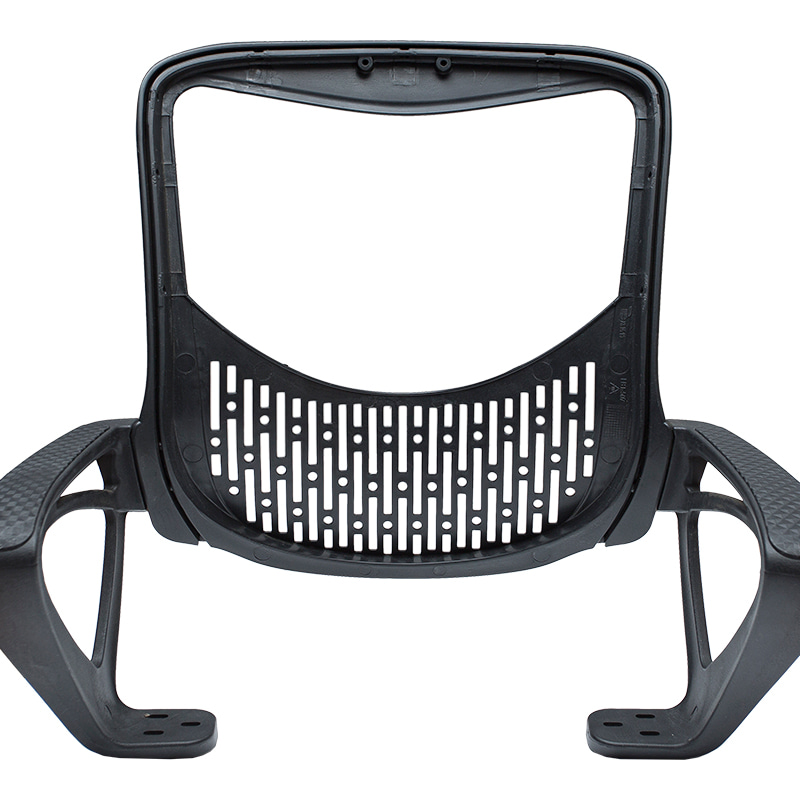
Structure matters as much as resin. Single-shot injection-molded back frames remove the separate lumbar bracket, and with it the screws that loosen, the joint that squeaks, and the assembly step that creates unit-to-unit variation. Zhejiang Lubote Plastic Technology Co., Ltd., a plastics manufacturer based in China, builds its back frame program around that logic, and the full plastic back frame range shows how much profile variation is possible inside a single molded part.
 LBT-F01PP Streamline Plastic Back FrameLBT-F01PP Plastic Back Frame (Backrest) is a carefully designed seat accessories made of high-quality polypropylene (PP) material, made through advanced injection mold...View Product →
The LBTF01PP streamline back frame is a useful reference: a molded shell that carries its own lumbar profile without a separate metal sub-frame, light enough for a mesh chair yet stiff enough to hold an S-curve under daily load.
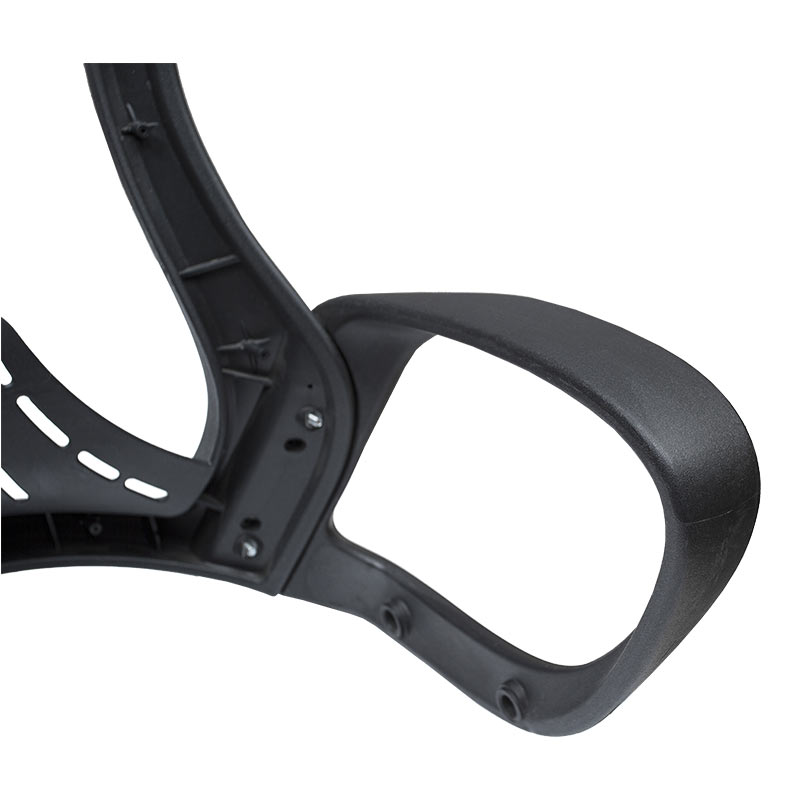
 YX-001 Injection Molded Single-Molded Plastic Back FrameYX-001 Injection Molded Single-Molded Plastic Back Frame is made of high-quality polypropylene (PP), which is known for its outstanding physical and chemical propertie...View Product →
For volume programs, one-piece molding also reduces incoming inspection points. Fewer parts means fewer tolerances to chase, fewer supplier audits, and a shorter assembly line, which is where most field failures are born.
Write the specification around the user population, not the average user. Four steps cover most of the commercial risk.
Collect the 5th to 95th percentile height and weight range of the people who will actually sit in the chair, then convert that range into required travel.
"Adjustable lumbar support" is not a specification. "60 mm vertical travel with 30 mm protrusion and 120 N of return force" is a specification a mold shop can quote against.
Ask for the resin grade, the glass content, and the wall thickness at the lumbar apex. Require a creep test at elevated temperature, not only a static load test at room temperature.
Confirm five to seven year availability of the back frame and lumbar mechanism from the same tooling, or every repair in year four becomes a full chair replacement.
A height and depth adjustable lumbar system typically adds only a single-digit percentage to the factory cost of a mid-range task chair. The cost of omitting it appears later and much larger.
Three sourcing risks deserve their own clause in the purchase agreement.
Aim for the pad to sit at the belt line, roughly 15 to 25 cm above the seat surface. Height adjustment of at least 5 cm is what makes that possible across a mixed group of users.
Neither is universally better. Mesh manages heat and humidity well but needs a shaped frame underneath to hold the lumbar curve. A padded back is easier to contour but retains more heat, so the choice depends on climate and duty cycle.
Beyond roughly 4 cm of protrusion, most users feel pressure on the pelvis rather than support in the lower back. Depth adjustment exists precisely because the right number differs from person to person.
Sometimes. If the back frame accepts an accessory pad or a replacement bracket, support can be retrofitted. If the frame is a solid flat panel, no accessory will recreate the curve, and the honest answer is a new chair.
The cheapest moment to solve lower back complaints is in the specification, not in the warranty claim. Define the population, write the numbers, verify the resin, and the chair will still be holding its curve when the lease comes up for renewal.
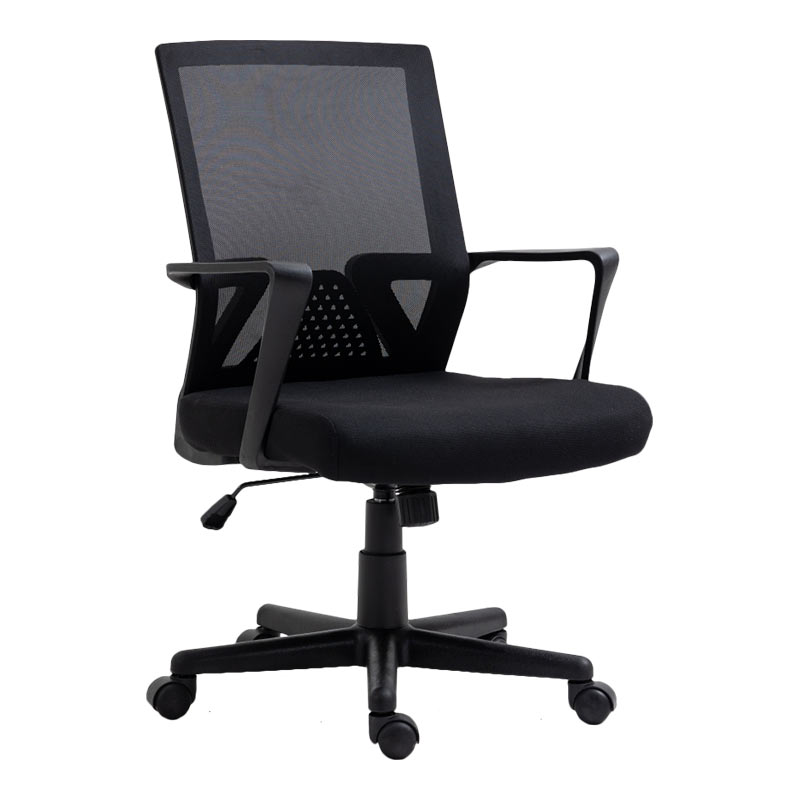
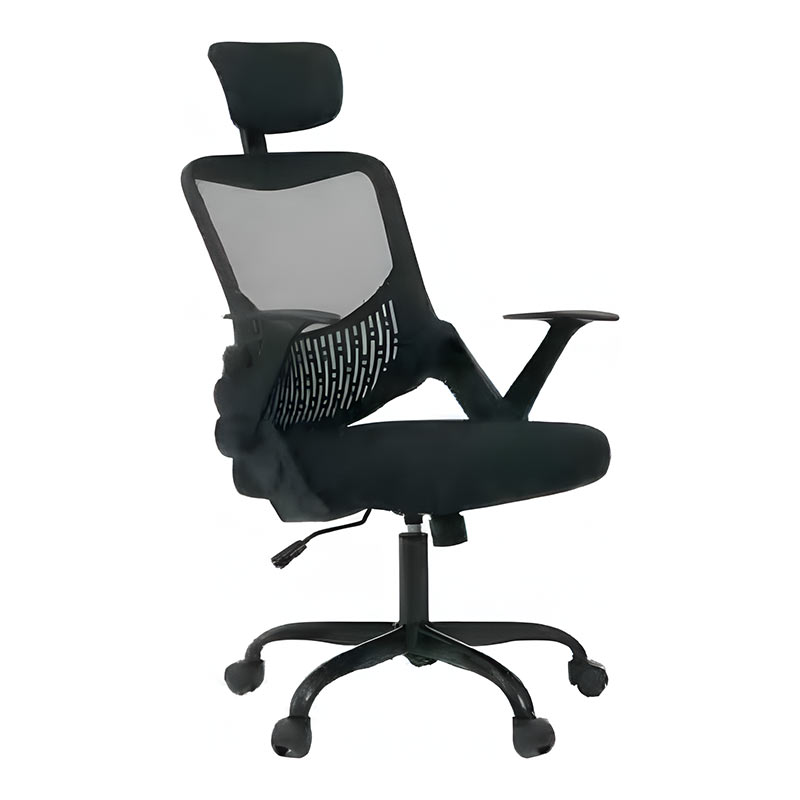 BY-8232 Ergonomic Mesh ChairThe BY-8232 mesh chair is made of high-quality mesh fabric, which is breathable and effectively relieves the stuffy discomfort caused by long-term sitting postures, al...View Product →

Call Us
+86 0572-5911661

Need Support

Head Office
ADD:Baishuiwan Industrial Park, Anji County, Zhejiang Province
Copyright © 2025Zhejiang Lubote Plastic Technology Co. , Ltd.
All Rights Reserved.Custom Chair Replacement Accessories Factory

