

 En
 Español
Call Us
+86 0572-5911661
 Home / News / Industry news / Adjustable Armrests: How They Cut Office Chair Returns and Boost Comfort

2026-11-02
A returned office chair is usually not a broken chair. It is a chair that never fit the person sitting in it, and the part that takes the blame first is almost always the armrest.
Returns and warranty teams rank armrest fit alongside seat height and lumbar pressure among the three most common reasons a task chair comes back inside the first month. The failure mode is predictable: a user's elbow height is fixed by their body, the workstation height is fixed by the building, and the only part of the equation that can move is the armrest. Adjustable armrests open a 60 to 110 mm vertical window plus a few degrees of fore and aft and pivot travel, which is enough to close that gap for nearly every adult build.
Definition: adjustable armrests are seat- or back-frame-mounted supports whose height, and usually fore-aft position or pivot angle, can be changed by the user without tools, and which hold the set position under sustained forearm load.
Content
Adjustable armrests improve comfort because they let the user hold the elbows at roughly 90 degrees with the forearms level, so the weight of the arms rests on the pad instead of being carried by the shoulder and neck muscles.
Ergonomic seating guidance such as ISO 9241-410, and the armrest load cases inside ANSI/BIFMA X5.1, treat that geometry as the baseline for seated work rather than an optional extra. When the pad sits 20 to 30 mm below the elbow, the user has two options: drop the shoulder down to the pad, or lift the forearm away from it. Both keep the upper trapezius in continuous low-level contraction, which is why the complaint is usually described as a tiring chair rather than a painful one.
Two secondary effects show up in production. First, armrest height changes the seat width a user perceives, so a narrow chair with correctly positioned pads feels more generous than a wide chair with pads set too low. Second, the pad surface decides whether the position can actually be held: a 40 mm PU pad spreads forearm pressure, while a thin hard shell concentrates it on the ulnar nerve at the elbow.
Comfort is not determined by how many levers an armrest carries. It is determined by whether the available travel spans the difference between the user's build and the desk they actually sit at, and across a normal adult office population that difference reaches roughly 120 mm of elbow height.
| Adjustment axis | Typical useful range | Complaint it resolves | Specification to verify |
| Height | 60 to 110 mm above the seat | Elbows hanging below the pad; pressure at the elbow | Lock increments no larger than 20 mm; 100 kg static load |
| Fore-aft slide | 40 to 60 mm | Pads colliding with the desk edge; wrists bent upward | Rail friction retained after 20,000 cycles |
| Inward pivot | 15 to 30 degrees | Rounded shoulders and rib compression on narrower builds | Pivot torque low enough to move while seated |
| Recline linkage | 10 to 30 degrees of tilt with the backrest | Loss of arm contact when the user leans back | Linkage tested as part of the mechanism assembly |
Height and fore-aft travel solve most first-week complaints. The linkage axis solves the complaint that arrives later, once a user has settled into a reclined working posture. In a recline-linked design the pad follows the backrest angle, so the forearm stays supported at 110 degrees of recline as well as at 90.
If a program can only fund one axis, fund height. It removes the largest share of fit complaints, and it is the setting users adjust most often in the first week.
Two-point linkage brackets such as the YX073PP are built for exactly that job: the armrest changes angle with the backrest instead of staying horizontal while the user's arm moves away from it.
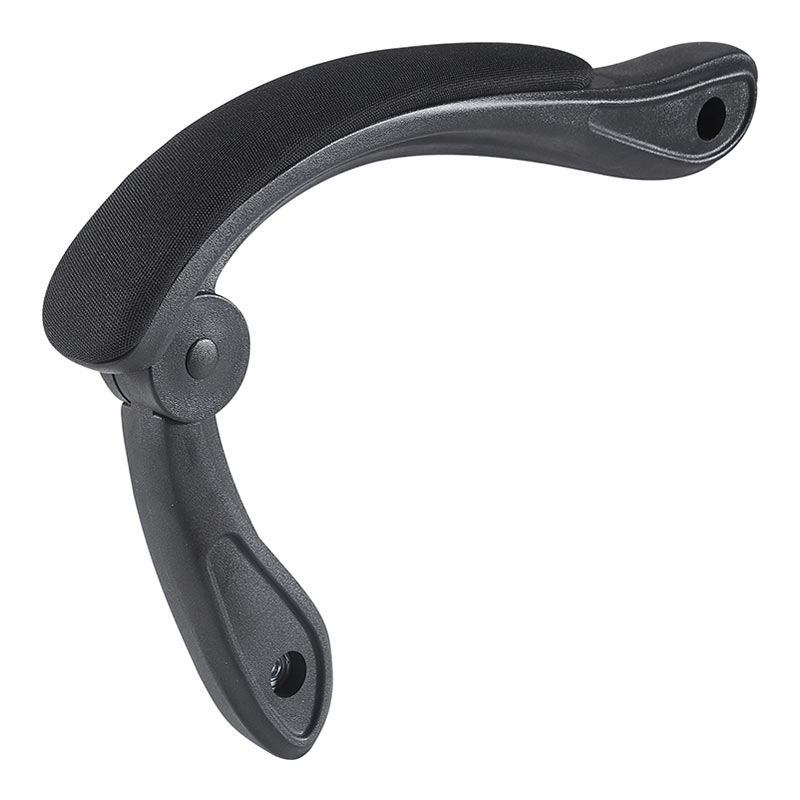 YX-073PP Two-Point Linkage Can Lie Down Plastic Handrail (Bracket)YX-073PP plastic armrests (brackets) are a carefully crafted accessories for e-sports chairs and mesh chairs. They introduce a cutting-edge two-point linkage design, a...View Product →
Adjustable armrests reduce returns because they remove the fit mismatch a buyer cannot repair after delivery. A retailer can replace a gas lift; it cannot ask a customer to change the length of their forearms.
Return economics explain why this matters more than the component price. A returned chair carries reverse freight, inspection, cleaning, repackaging and a resale markdown, so one return typically costs one and a half to three times the landed price of the armrest bracket itself. An adjustable bracket costs a few dollars more at the factory and removes that risk entirely.
There is a catalog effect too. When a single SKU covers a wider band of body heights, a distributor carries fewer size variants, which reduces slow-moving stock and the write-offs that follow it. Programs that move from fixed to three-axis adjustable armrests usually find that armrest complaints stop arriving as a category, and the returns that remain are mechanical, easier to diagnose and easier to design out.
Neither design wins everywhere. Fixed armrests are the right answer for stacking chairs, training rooms and waiting areas, where the armrest simply defines the edge of the seat. Adjustable armrests become mandatory the moment a product is sold as an all-day working chair.
For programs that ship a finished chair rather than loose components, the same logic applies at model level, because armrest travel, seat depth and lumbar support have to be specified together or the chair simply moves the complaint to another part of the body. A model such as the BY8246 adjustable office chair pairs three-axis armrests with height adjustment precisely because those two settings interact.
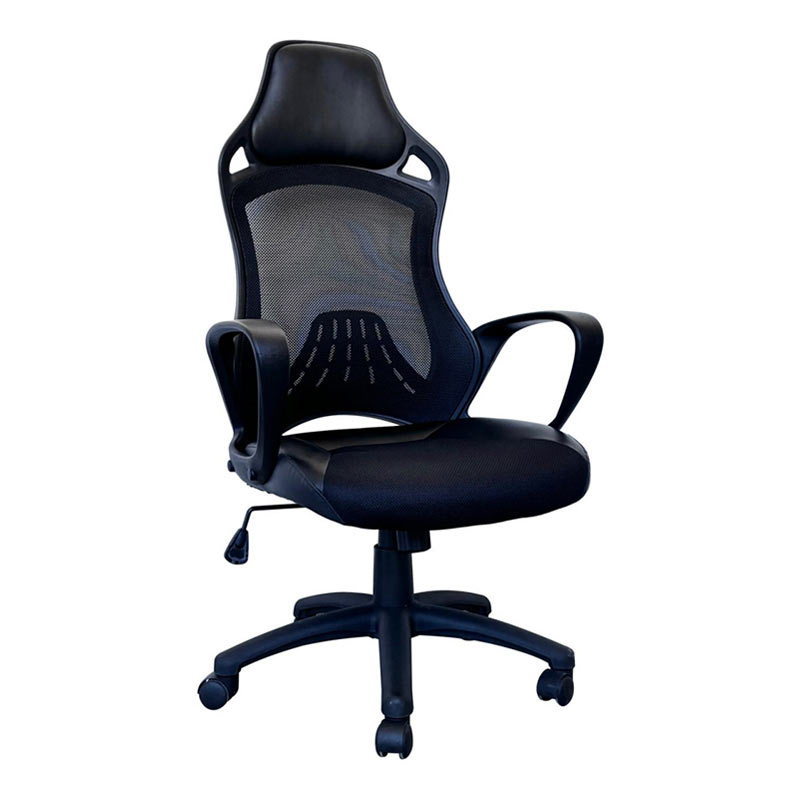 BY-8246 Adjustable Office ChairThe BY-8246 office chair is made of high-strength materials, with strong load-bearing capacity and ensuring stability for long-term use. The backrest of the chair is d...View Product →
Specify adjustable armrests by load case, cycle count and position lock before appearance. Geometry and material decisions are reversible on a drawing and expensive to reverse once tooling is cut.
Zhejiang Lubote Plastic Technology Co., Ltd. produces this component group alongside back frames, seat shells, bases and casters, and runs both ODM and OEM programs, which matters when a bracket has to be matched to an existing seat shell instead of designed from scratch. Geometry, pad material and finish are normally locked in the first tooling round, so review the adjustable armrest and handrail bracket range before committing to a bolt pattern. Independent brackets such as the AD03 suit chairs where the armrest mounts directly to the seat shell rather than to the mechanism.
 AD-03 PP material,independent armrest Chair AccessoriesThe AD-03 is an independent armrest chair accessory constructed from PP (polypropylene) material, characterized by its reinforced gusseted top surface for structural d...View Product →
They do both, and the second effect drives the first. A complaint that can be answered with an adjustment stays a support ticket; a complaint that cannot be answered becomes a return. Armrest fit is the part of a chair customers diagnose immediately, so removing it removes the returns that arrive in the first month, when reverse logistics costs the most.
At least 60 mm of height travel plus 40 mm of fore-aft slide covers most adult users at a standard 740 mm desk. For chairs sold online without a showroom trial, 100 mm of height travel is the safer target. Below 40 mm of travel the armrest is adjustable in name only.
Only when the fourth axis solves a real problem for the user group. Height and fore-aft travel handle elbow height and desk clearance; the pivot axis helps narrower builds, and the recline linkage matters for gaming, drafting and long video sessions. On a basic task chair the fourth axis adds cost without changing the fit.
Sometimes, but the bolt pattern, seat shell boss height and bracket footprint all have to match, and retrofitting usually costs more per unit than specifying adjustable brackets on the next production run. Check the mounting interface first, then compare bracket geometry against the seat shell drawing before quoting.
Recommended Products

Call Us
+86 0572-5911661

Need Support

Head Office
ADD:Baishuiwan Industrial Park, Anji County, Zhejiang Province
Copyright © 2025Zhejiang Lubote Plastic Technology Co. , Ltd.
All Rights Reserved.Custom Chair Replacement Accessories Factory

