

 En
En
 Español
Call Us
+86 0572-5911661
 Home / News / Industry news / The Engineering Science Behind the Modern Office Mesh Chair: A Technical Deep Dive
2026-02-24
In the modern workspace, the Office Mesh Chair has transcended its status as mere furniture to become a critical component of occupational health and mechanical engineering. Designing an ergonomic mesh chair for back pain prevention requires a deep understanding of human kinesiology and material science. Unlike traditional padded seating, a high-performance Office Mesh Chair utilizes tensioned elastomers to distribute body weight evenly, reducing pressure points on the ischial tuberosities. This article explores the technical specifications, durability standards, and ergonomic benefits of advanced mesh seating solutions.
Content
The primary advantage of a breathable mesh office chair is its ability to facilitate passive thermal regulation. From an engineering perspective, the ""breathability"" is determined by the open-weave percentage of the polyester or nylon mesh. While foam-based chairs act as thermal insulators, trapping body heat and moisture, mesh allows for constant airflow. Furthermore, the durability of mesh vs fabric office chairs is often debated; however, modern technical mesh is engineered with high-tenacity yarns that resist sagging over time, provided the initial tensioning during manufacturing meets BIFMA standards.
| Feature | Traditional Foam/Fabric Chair | Breathable mesh office chair |
| Thermal Regulation | Low (Heat retention) | High (Passive airflow) |
| Pressure Distribution | Static (Compressed foam) | Dynamic (Tensioned suspension) |
| Moisture Wicking | Poor (Absorbs sweat) | Excellent (Non-absorbent) |
A high back mesh chair with lumbar support is designed to maintain the natural ""S"" curve of the human spine. Engineers focus on the ""lumbar prominence""—the part of the backrest that pushes forward into the lower back. The effectiveness of this support depends on the mesh tension; if the mesh is too soft, the user's pelvis tilts backward (posterior pelvic tilt), leading to lumbar disc compression. When comparing a mesh office chair vs leather chair for long-term health, mesh provides a ""cradle"" effect that adjusts to the user's micro-movements, whereas leather provides a fixed, often non-contoured surface that can lead to postural fatigue.
| Ergonomic Factor | Leather/Executive Chair | High back mesh chair with lumbar support |
| Spinal Contour | Generic/Fixed | Adaptive/Precision-contoured |
| Pelvic Support | Flat surface | Contoured ""Waterfall"" edge |
| Movement Support | Rigid | Dynamic/Flexing |
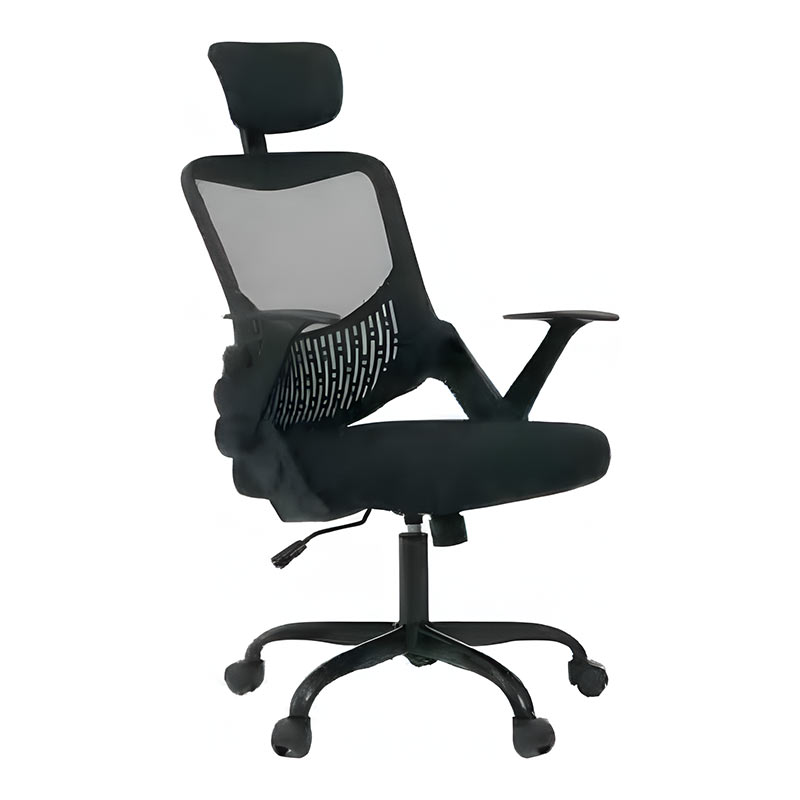
An adjustable mesh office chair with headrest incorporates synchronized tilt mechanisms (synchro-tilt) that allow the backrest to recline at a higher ratio than the seat. This maintains the user's feet flat on the floor while opening the torso angle, which is essential for respiratory efficiency and circulation. For users in corporate environments, knowing how to adjust mesh chair for better posture is vital. Technical features like 4D armrests and seat depth adjustment ensure that the Office Mesh Chair accommodates various percentiles of the human population (from the 5th to the 95th percentile), reducing the risk of musculoskeletal disorders.
The structural longevity of an ergonomic task chair is measured by its resistance to cyclic loading. Heavy duty mesh chair for 24/7 use must pass rigorous testing, including seat drop tests and back durability cycles (often exceeding 100,000 repetitions). A common concern is how to clean mesh office chair effectively without damaging the tension fibers. Engineers recommend using pH-neutral cleaners and avoiding abrasive brushes to maintain the integrity of the elastomeric weave, which is vital for preventing the mesh from losing its ""rebound"" property over years of use.
| Standard Test | Residential Grade Chair | Heavy duty mesh chair for 24/7 use |
| Weight Capacity | Up to 200 lbs | 300 - 500 lbs |
| Base Material | Nylon/Plastic | Reinforced Aluminum/Steel |
| Mesh Life Expectancy | 2-3 Years | 5-10+ Years |
The Office Mesh Chair represents the pinnacle of task-oriented seating. By combining high-tenacity fibers with precision mechanical adjustability, these chairs offer a superior solution for the modern, health-conscious professional. Whether you are addressing existing discomfort or proactively outfitting a new office, the technical advantages of mesh—ranging from thermal management to dynamic spinal support—make it the definitive choice for long-term productivity and well-being.
Yes. Mesh is objectively superior for heat dissipation. Leather and foam trap heat against the body, whereas mesh allows for 360-degree airflow, keeping the user cool and reducing perspiration.
Start by setting the seat height so your feet are flat and knees are at 90 degrees. Adjust the lumbar support so it fits the small of your back, and ensure the seat depth allows you to sit fully back without pressure behind your knees.
Use a vacuum with a brush attachment to remove dust between the fibers. For stains, use a damp cloth with mild soap. Avoid soaking the mesh, as excessive moisture can affect the tensioning frame over time.
Heavy-duty chairs feature reinforced frames, higher-grade gas lifts, and ""high-elasticity"" mesh that can withstand constant use without sagging. They are specifically tested for multi-shift environments.
Because mesh provides ""distributed suspension."" It doesn't have hard spots like poorly designed foam, which helps in reducing pressure on the spine and promoting blood flow during long sedentary periods.
Recommended Products

Call Us
+86 0572-5911661

Need Support

Head Office
ADD:Baishuiwan Industrial Park, Anji County, Zhejiang Province
Copyright © 2025Zhejiang Lubote Plastic Technology Co. , Ltd.
All Rights Reserved.Custom Chair Replacement Accessories Factory

