

 En
En
 Español
Call Us
+86 0572-5911661
 Home / News / Industry news / Plastic Backrest & Plastic Back Frame: Materials, Design & Sourcing Guide
2026-06-15
Content
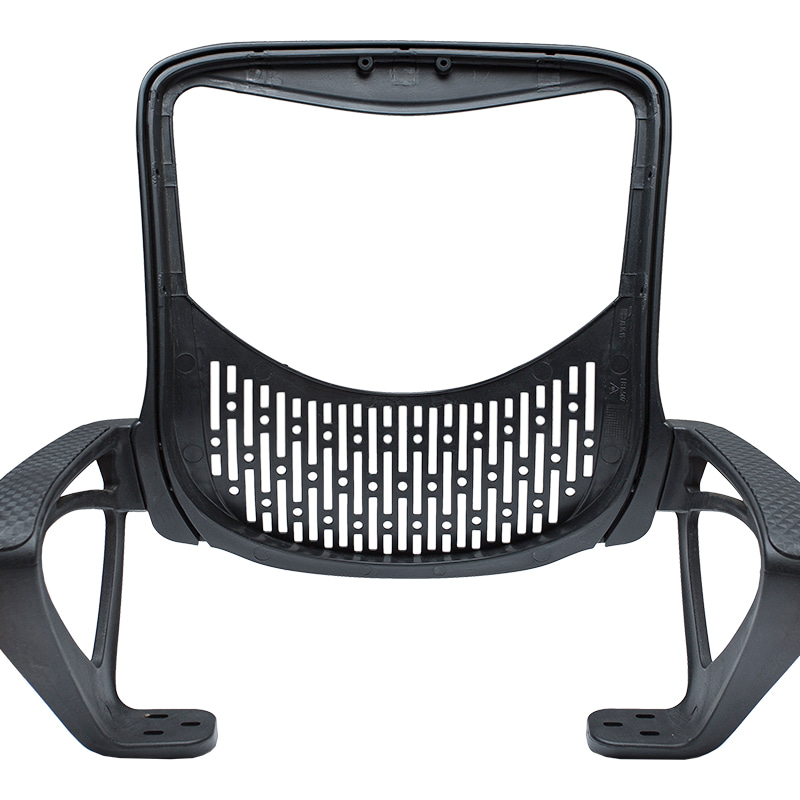
A plastic backrest refers to the complete back assembly of a chair — the finished surface that contacts the sitter's spine, lumbar region, and shoulder blades. A plastic back frame, by contrast, is the structural skeleton beneath or behind that surface: the load-bearing perimeter or internal lattice that gives the backrest its shape and anchors it to the chair's seat and legs. In low-cost or mass-market seating, the two are often one molded piece. In mid-to-high-end commercial and office furniture, they are separate components made from different materials, each optimized for its function — the frame for rigidity and fatigue resistance, the backrest shell for surface feel, breathability, or aesthetic flexibility.
Understanding this distinction matters for procurement, replacement parts sourcing, and quality evaluation. A chair with a cracked outer plastic backrest may still have a structurally sound frame; replacing only the shell is far less expensive than replacing the entire back assembly. Conversely, a frame failure is a safety issue that requires complete back unit replacement regardless of how intact the surface panel appears.
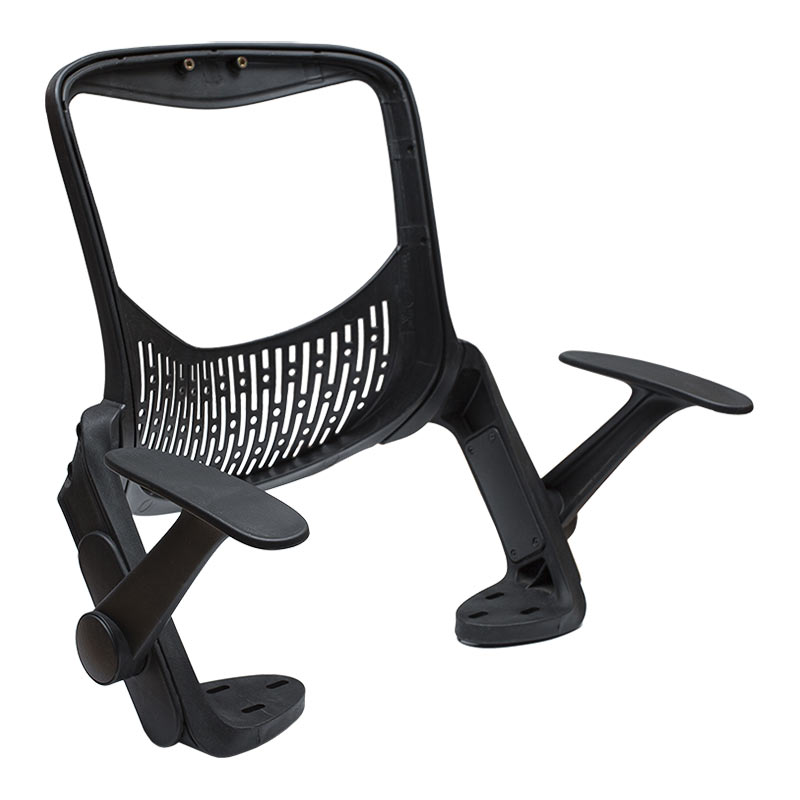
Not all plastics are equal in seating applications. The material choice fundamentally affects load capacity, flex behavior, UV stability, and service life. The four most commonly used resins are polypropylene, nylon, ABS, and glass-fiber-reinforced composites.
Polypropylene is the dominant material for budget and mid-range plastic backrests. It offers a good balance of impact resistance, chemical resistance, and recyclability at low raw material cost. PP has a natural flex that allows thin-section backrests to act as a living hinge, providing passive lumbar give without foam or mesh. The main limitations are creep under sustained load at elevated temperatures — important in outdoor and automotive seating — and UV degradation that causes surface chalking and embrittlement over time without stabilizer additives.
Nylon is the preferred resin for plastic back frames in office and task chairs. Its tensile strength (typically 70–85 MPa for PA66) and fatigue resistance under cyclic loading are substantially higher than polypropylene. Nylon's ability to absorb moisture reduces brittleness — a benefit in low-humidity environments where PP and ABS can become notch-sensitive. The primary drawback is moisture absorption causing dimensional change, which must be managed in precision-fit assemblies through allowance tolerances or stabilized nylon grades.
ABS is widely used for plastic backrests in office and hospitality seating where surface appearance matters. It accepts paint and chrome plating easily, has excellent dimensional stability, and produces a high-gloss surface finish directly from the mold without secondary operations. ABS is less impact-resistant than polypropylene at low temperatures and is not recommended for outdoor applications without UV stabilization. In two-component back assemblies, ABS is frequently used for the visible outer shell while nylon or glass-filled PP handles the structural frame.
Adding 15–30% short glass fiber to PP or nylon dramatically increases stiffness and reduces creep. Glass-filled nylon back frames used in ergonomic office chairs can sustain dynamic loads exceeding 150 kg without permanent deformation — roughly double the load capacity of unfilled PP at equivalent wall thickness. The trade-off is increased brittleness at stress concentrations such as screw bosses and snap-fit hooks, requiring careful gate location and rib geometry during tool design.
| Material | Typical Tensile Strength | UV Resistance | Best Application |
|---|---|---|---|
| PP (unfilled) | 25–40 MPa | Low (needs additive) | Budget backrest shells |
| PA66 (unfilled) | 70–85 MPa | Moderate | Structural back frames |
| ABS | 40–55 MPa | Low (indoor only) | Decorative outer shells |
| PA66-GF30 | 160–190 MPa | Moderate | High-load ergonomic frames |
A plastic back frame must resist several simultaneous load cases: vertical compressive loads from the sitter leaning back, lateral loads from side impacts, and cyclic fatigue from repeated recline-and-release cycles over the product's intended service life. Poor frame design is the most common root cause of back assembly failure in commercial seating — far more common than material failure.
Two dominant structural philosophies exist. The perimeter frame design uses a continuous closed-loop border around the back, with the backrest shell or mesh suspended within it. This approach concentrates material at the outermost fibers where bending stress is highest, maximizing stiffness-to-weight efficiency. The internal lattice design integrates structural ribs throughout a solid-back shell, distributing load across a larger area. Lattice designs allow thinner nominal wall sections and reduce visible sink marks on the show surface, but are more sensitive to gate location and fiber orientation in glass-filled resins.
The most failure-prone zones in any plastic back frame are the connection points where the frame attaches to the seat mechanism or chair legs. Screw bosses, pivot pins, and snap-fit hooks create geometric stress concentrations that multiply local stresses by factors of 2–5x compared to the nominal section. These areas require:
Premium plastic backrests incorporate a deliberately thinned lumbar zone — typically 1.8–2.5 mm wall versus 3.5–5 mm at the frame perimeter — to create passive flex that follows the user's spine under load. This requires finite element analysis (FEA) to ensure the thin section yields elastically but not plastically under the design load. If the lumbar zone is too thin for the chosen resin, it will develop stress-whitening or permanent set within weeks of use.
The vast majority of plastic backrests and back frames are produced by injection molding. Part size, wall section variation, and material choice each introduce specific process challenges that directly affect dimensional accuracy, surface quality, and structural integrity.
Chair backs are large, thin-walled parts — typical projected areas of 800–2,500 cm². Filling such a part uniformly requires carefully balanced runner systems and, in most cases, multiple gates or a hot-runner manifold. The gate location determines fiber orientation in glass-filled materials, weld line position, and the surface appearance of the show face. Fan gates along the top edge are common for back frames because they minimize witness lines on the seating surface.
Warpage is the principal quality issue in large plastic backrests. Differential cooling across the part thickness and along flow length creates residual stress that causes the part to bow out of the mold. Key controls include:
Plastic backrests can be produced with a range of surface textures directly from the mold — from high-gloss Class A surfaces to fine grain textures (VDI 12–27 range) that hide minor flow marks and fingerprints. Matte and semi-gloss textures are preferred for commercial seating because they maintain appearance through extended use. Post-mold options include painting, UV-cured coating for scratch resistance, and two-shot or insert molding for soft-touch overmolded contact surfaces.
Plastic backrests and back frames serve substantially different performance requirements depending on the end-use segment. Procurement specifications should be matched to the actual use environment rather than defaulting to the lowest-cost option across all applications.
Office seating standards such as EN 1335 (Europe) and ANSI/BIFMA X5.1 (North America) require back frames to withstand static rear-impact loads of 1,000–1,500 N and cyclic recline tests of 100,000+ cycles without structural failure. Back frames in this segment are almost exclusively nylon or glass-filled nylon. The plastic backrest shell is secondary — its role is ergonomic contouring and upholstery anchoring rather than load bearing.
In stacking chairs for hospitality and event venues, the plastic backrest and back frame are typically a single monolithic PP molding. The priority is impact resistance (handling damage during stacking and transport), UV stability for outdoor events, and cleanability. Wall sections run thicker — 3–5 mm — to absorb side impacts. Stackability geometry requires the back profile to nest without marking adjacent chair surfaces, which drives specific draft angle and texture decisions in the tool.
Outdoor plastic backrests face UV radiation, thermal cycling (−20°C to +60°C in many climates), and moisture exposure simultaneously. PP with UV stabilizer packages and carbon black pigmentation remains the most cost-effective solution for mid-range outdoor furniture. High-density polyethylene (HDPE) is increasingly used in premium outdoor seating because of its superior UV and chemical resistance, though its lower stiffness requires thicker sections or integrated ribbing to achieve comparable back rigidity.
Automotive seat back frames are subject to crash-load requirements (ECE R17 and FMVSS 207/210) that far exceed any commercial furniture standard. These applications use glass-fiber-reinforced PP or PA structures validated through extensive FEA and physical testing. The plastic back frame in a vehicle must maintain occupant restraint under rear-impact scenarios, which imposes design and material standards unavailable in standard furniture-grade components.
For buyers sourcing plastic backrests or back frames from manufacturers, several criteria distinguish reliable components from those likely to fail prematurely in service.
Recommended Products

Call Us
+86 0572-5911661

Need Support

Head Office
ADD:Baishuiwan Industrial Park, Anji County, Zhejiang Province
Copyright © 2025Zhejiang Lubote Plastic Technology Co. , Ltd.
All Rights Reserved.Custom Chair Replacement Accessories Factory

