

 En
 Español
Call Us
+86 0572-5911661
 Home / News / Industry news / How to Choose Lumbar Support and Ergonomic Backrest for Your Gaming Chair

2026-10-19
Choosing lumbar support and an ergonomic backrest for gaming chairs comes down to five measurable decisions: protrusion depth, height range, contact width, frame stiffness, and material resilience.
The checks below follow the same logic we use in our comprehensive guide to ergonomic backrests.
Content
Lumbar support quality is decided by protrusion depth, vertical adjustment range, contact width, and frame stiffness, in that order.
Intradiscal pressure is the hydraulic load inside an intervertebral disc. Relaxed sitting produces about 0.46 MPa at the L4-L5 disc; a correctly placed 30-50 mm lumbar slope lowers it to roughly 0.30 MPa, close to standing values.
Protrusion depth is the first spec. The useful window is 30-50 mm. Below 20 mm, the pad touches fabric but does not change spinal loading. Above 50 mm, it tilts the pelvis backward and shifts the strain to the sacrum.
Height range is second. The L3-L4 segment sits at a different height on every torso, so the pad should travel at least 80-100 mm. A fixed bump only works when the whole shell is height-adjustable, which is rare on budget gaming chairs.
Contact width is the overlooked spec. A narrow foam puck concentrates force; a pad at least 20-25 cm wide spreads the load and feels supportive rather than intrusive.
Four mechanisms dominate the market. Compare them on height travel, depth range, and durability under a sustained load.
| Support type | Height travel | Depth range | Durability under 90 kg | Best use case |
| Fixed foam bump | None | 15-25 mm | Loses shape in 3-6 months | Budget chairs |
| Inflatable air bladder | Wide | 0-50 mm | Valve wear and leak risk | Casual home use |
| Adjustable plate plus foam pad | 80-100 mm | 20-50 mm | High, pad replaceable | Long gaming sessions |
| Integrated backrest curve | Tool-free steps | 20-40 mm | High, no moving parts | OEM and brand programs |
The frame, not the padding, keeps the lumbar contour stable. A single-piece injection-molded plastic backrest with a reinforced lumbar bridge holds shape better than a welded metal tube frame with a bolted plate.
Metal tube frames bend a steel tube into a C-profile, weld a lumbar plate across the opening, and cover it with foam. The weld becomes the stress concentration point, and the plate rotates under lateral load.
Single-piece plastic backrests remove both problems. The lumbar contour is machined into the injection mold, so every unit leaves the press with the same curve. Nylon and glass-reinforced PP carry repeated recline cycles without creep.
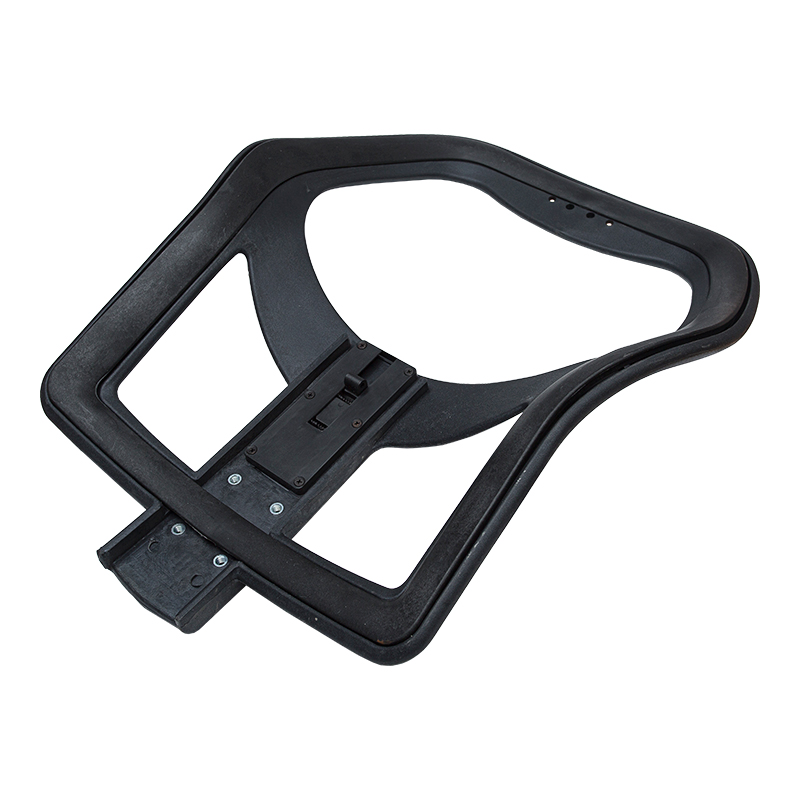
Ask for deflection data before approving a sample. A frame with 2.5 mm walls in the lumbar zone flexes a few millimeters under a 60 kg push load; below 2.0 mm, it creeps within about 12 months. The LBTF01PP streamline back frame routes reinforcing ribs through the lumbar bridge so the S-curve survives years of full recline.
 LBT-F01PP Streamline Polypropylene Back Frame with Reinforced Lumbar BridgeThis single-molded PP back frame routes reinforcing ribs through the lumbar bridge, maintaining the S-curve under full recline. Its deflection behavior under load should be reviewed alongside sample testing data.View Product →
The lumbar pad must sit between the top of the pelvis and the bottom of the ribcage, near the navel line, and keep its 30-50 mm protrusion through the full recline range.
The L3-L4 segment sits roughly 10-15 cm above the hip pivot on a 175 cm user. When the backrest reclines to 110-120 degrees, the gap between pelvis and pad changes. A pad mounted on a strap creeps every cycle; a pad fixed to the rigid shell stays put.
Watch the pad during recline. Some mechanisms rotate the lumbar plate backward as the backrest tilts, flattening the curve that was supporting you. Look for a pad that pivots independently or stays locked to the seat angle.
Buy on foam density, fabric abrasion, and frame certification, in that order. Anything below 40 kg/m3 foam or 50,000 Martindale cycles will not survive daily gaming.
Foam density is the first place manufacturers cut cost. Polyurethane at 25-35 kg/m3 feels plush in the showroom and flattens after three to six months. High-resilience foam at 40-60 kg/m3 rebounds after a 90 kg load and keeps its lumbar contour. Low-VOC foam matters in an enclosed room.
Cover material is second. PU leather ranges from thin film that splits at the lumbar seam to multilayer film that passes 50,000 Martindale cycles. Mesh is better at the lumbar zone, where perspiration is highest. The LBT508 comfortable plastic back frame pairs a single-piece shell with a pre-formed lumbar seat, keeping foam thin while the structural curve does the work.
 LBT-508 Compact Ergonomic Polypropylene Back Frame with Pre-formed Lumbar SeatA lightweight single-piece shell with a pre-formed lumbar seat lets the structural curve support posture while keeping foam thin. Suitable for homes, offices, and public settings where durability and easy cleaning matter.View Product →
Frame certification closes the list. BIFMA X5.1 is the minimum structural benchmark, including a 102,000-cycle tilt test and a backrest drop test. For retrofit programs, our adjustable lumbar support products roundup covers bolt-on options.
For OEM sourcing, request four documents before quoting: frame deflection data, foam density certificate, fabric abrasion report, and dimensional tolerance measurements.
A brand that skips these checks inherits every hidden defect, from a lumbar curve that relaxes 3 mm after six months to a stripped insert at 1.5 Nm.
At Zhejiang Lubote Plastic Technology Co., Ltd., we design and produce plastic back frames, lumbar components, and finished gaming chair frames for ODM and OEM programs. The YX001 single-molded back frame replaces seven separate parts, removing assembly tolerance from the lumbar equation.
 YX-001 Single-Molded Polypropylene Back Frame Replacing Seven Separate PartsThis injection-molded frame consolidates multiple components into one piece, removing assembly tolerance from lumbar positioning. Its corrosion-resistant PP structure suits daily use and maintains color and texture over time.View Product →
Between 30 and 50 mm from the backrest surface. Less than 20 mm does not change spinal loading; more than 50 mm tilts the pelvis backward. Start near 35 mm and fine-tune from comfort.
Yes. L3-L4 sits at different heights on different torsos, so a fixed pad fits about one body type. Choose at least 80-100 mm of vertical travel and position the pad near the navel line.
If the shell has a rigid mounting surface, a bolt-on or strap-on plate works. Check frame deflection first; a flexible shell loosens any add-on pad within weeks. A one-piece backrest with an integrated lumbar curve outperforms every aftermarket attachment.
A metal tube frame carries a separate plate and depends on weld quality. A single-piece plastic frame builds the curve into the tool itself, keeping geometry identical on every unit. Nylon and glass-reinforced PP resist creep under recline loads.
Recommended Products

Call Us
+86 0572-5911661

Need Support

Head Office
ADD:Baishuiwan Industrial Park, Anji County, Zhejiang Province
Copyright © 2025Zhejiang Lubote Plastic Technology Co. , Ltd.
All Rights Reserved.Custom Chair Replacement Accessories Factory

